
A TikTok calculator estimates how much a creator might earn by multiplying qualified video views by an assumed rate per 1,000 views, known as RPM. Followers and engagement help refine the estimate, but views are what drive payment. Most published guides put the typical Creator Rewards rate at roughly $0.40 to $1.00 per 1,000 qualified views. TikTok does not publish a fixed rate, so every result is a planning estimate and not a payout.
This guide explains how those estimates work, which numbers to enter, why followers matter less than many people expect, and where username-based tools hit hard limits.
What a TikTok Calculator Actually Does
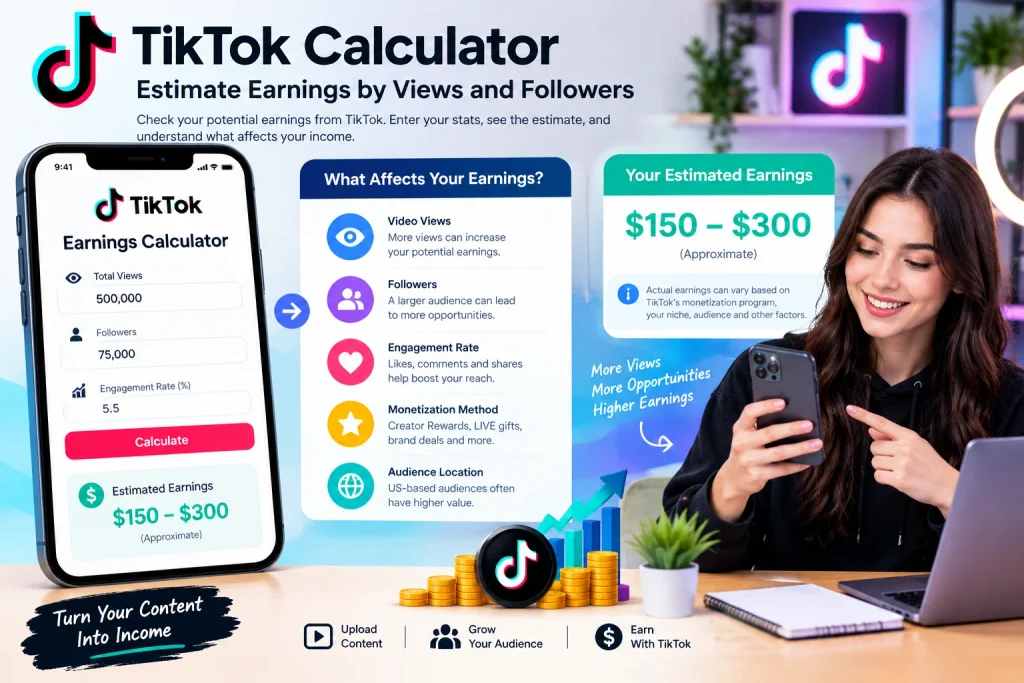
A TikTok calculator is a simple modelling tool. You enter a few inputs, usually views, followers, engagement or niche, and it applies assumptions to produce a range of possible income.
It does not connect to your TikTok account or read payment records. A calculator can show what your numbers might be worth under common benchmarks, but only your own dashboard shows what TikTok will actually pay. To check your real figures, log in on the official TikTok login page and review the analytics available to you.
The Formula Behind Most TikTok Earnings Estimates
Nearly every views-based estimate uses the same arithmetic:
Estimated earnings = (qualified views ÷ 1,000) × RPM
RPM stands for rewards per 1,000 qualified views. Under TikTok’s Creator Rewards Program, payment is based on qualified views and RPM, not on the total public view count. Qualified views generally exclude things like bot traffic and views from ineligible regions, so the number shown on a video is usually higher than the number that earns money.
Here is what the formula produces at the commonly reported range of $0.40 to $1.00 RPM:
| Qualified views | Low estimate ($0.40) | High estimate ($1.00) |
|---|---|---|
| 10,000 | $4 | $10 |
| 100,000 | $40 | $100 |
| 500,000 | $200 | $500 |
| 1,000,000 | $400 | $1,000 |
These figures illustrate the formula and are not guarantees. Some sources report higher RPMs for finance, tech or business content, but those are not typical.
Why Views Matter More Than Followers
If you searched for “TikTok follower earnings,” here is the honest answer: followers do not directly pay you. They matter in two indirect ways.
First, followers are a gate. To join the Creator Rewards Program, creators generally need to be at least 18, have at least 10,000 followers and have at least 100,000 views in the last 30 days, with the account in good standing in a supported country. Requirements can change, so confirm them in the app.
Second, followers influence reach. A larger, engaged audience tends to produce more views per video, and views are what the formula rewards. A creator with 20,000 followers and consistently high views can out-earn an account with 200,000 inactive followers.
That is why a good TikTok views calculator asks for views first and treats followers as supporting context.
How to Use a TikTok Calculator Step by Step
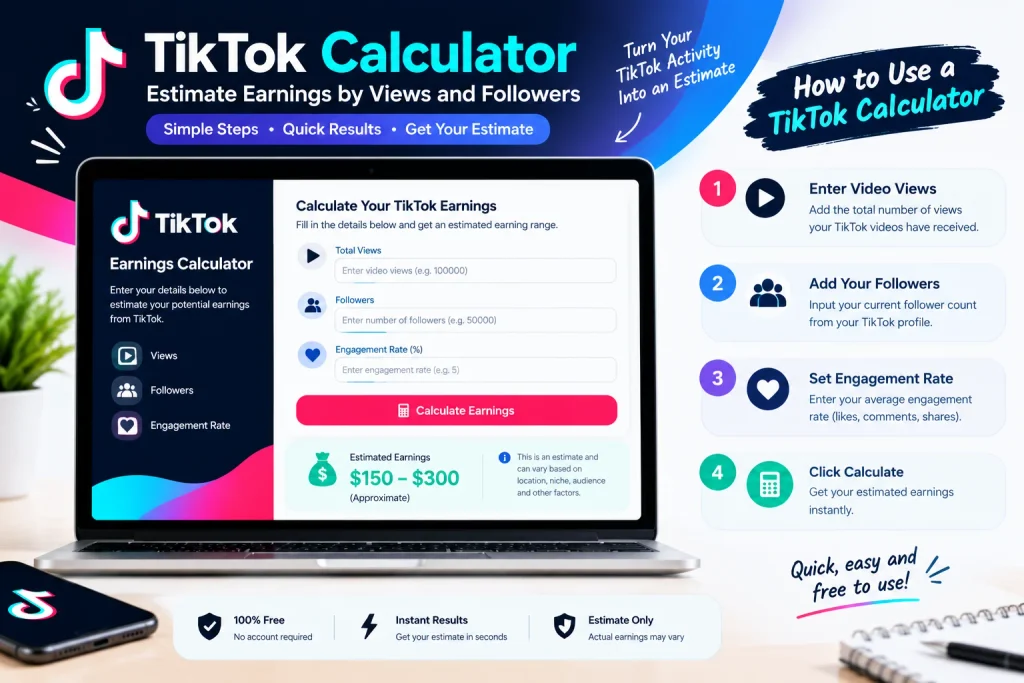
- Pull your real view data. Use your own analytics for the last 30 days, not a single viral video.
- Separate eligible content. Creator Rewards generally applies to original videos longer than one minute. Shorter clips usually do not earn through the program.
- Estimate your qualified share. If your analytics show it, use it. If not, test a conservative assumption, such as 60% of total views, and treat it as an assumption.
- Pick a range of RPMs. Run a low, middle and high scenario, for example $0.40, $0.70 and $1.00.
- Compare scenarios. The spread between them is the honest answer. A single number looks precise but hides uncertainty.
For example, a creator with 200,000 total views on eligible videos and a 60% qualified share has 120,000 qualified views. At $0.40 that is about $48, and at $1.00 about $120. Changing the qualified share alone can move that result a lot.
What Changes Your RPM
TikTok has said payouts depend on factors such as originality, play duration, search value and audience engagement. Creators and analysts also commonly point to a few practical influences:
- Niche. Educational, finance and business topics are widely reported to pay more than general entertainment, though TikTok does not publish niche rates.
- Audience location. Viewers in some markets are worth more to advertisers than others.
- Watch time. Videos that hold attention tend to perform better than ones people swipe away from.
- Video quality and originality. Reposted or low-effort content is less likely to qualify.
Because these factors shift, your own RPM, which TikTok shows inside the program dashboard once you are enrolled, is always better than a generic benchmark.
TikTok Calculator by Username: What Is Possible
Many tools let you type a public @username and return an income figure. It helps to understand what is actually happening.
Such a tool can only see public information: follower count, public view counts, posting frequency and visible engagement. It then applies the same assumptions described above. It cannot see private payout data, RPM, qualified views, brand-deal fees or taxes. Only the account owner can see their own earnings in the app.
LIVE earnings follow the same rule. TikTok shows Diamond balances to the account owner only, so any figure for another creator’s LIVE income is an estimate based on assumed rates. For a deeper explanation, read our guide on how to check TikTok LIVE earnings by username.
Used sensibly, a username tool is fine for rough comparison. It should not be treated as proof of what anyone actually makes.
Using a TikTok Engagement Calculator
Engagement does not appear in the basic earnings formula, but it explains why some accounts outperform others. The standard calculation is:
Engagement rate = (likes + comments + shares) ÷ views × 100
For example, 3,000 interactions on 60,000 views is a 5% engagement rate. Some calculators divide by followers instead of views, so check which method a tool uses before comparing results.
Engagement is most useful as a quality signal. Brands often look at it when evaluating creators, and videos that spark comments and shares are more likely to be recommended to new viewers. Treat it as a diagnostic, not a payment multiplier.
Income Beyond Views
A TikTok influencer income calculator that only counts views misses much of the picture. Creators may also earn from:
- Brand partnerships, which are often negotiated per post and can exceed program payouts for creators with engaged audiences.
- TikTok Shop and affiliate commissions, which are tied to sales rather than views.
- LIVE gifts, where eligible creators receive Diamonds from viewers.
- Subscriptions and tips, where available.
A views-only estimate is therefore a floor for some creators and a ceiling for others. Many creators who earn well treat the view payout as one stream among several.
Common Mistakes When Estimating TikTok Income
- Using total views instead of qualified views. This overstates income.
- Using one viral video as a monthly average. Spikes are not a baseline.
- Applying a high RPM from another niche. Match the benchmark to your content type.
- Ignoring tax and platform deductions. Estimates are not take-home pay.
- Trusting precise-looking numbers. A result like $1,847.32 suggests a certainty no outside tool has.
- Buying followers or views to hit thresholds. The program counts authentic activity, and inflated numbers can put eligibility at risk.
Conclusion
A TikTok calculator is most valuable as a planning tool. It helps you see how a change in views, eligible video length or niche might matter, and it gives brands a rough sense of scale. It cannot reveal private payouts, and it cannot replace your own dashboard.
Collect your last 30 days of real view data, run low, middle and high scenarios, and compare them with the numbers in your account. Then try the TikTok Money Calculator to model your own inputs.
Frequently Asked Questions
How accurate is a TikTok calculator?
It is only as accurate as its assumptions. With real qualified views and a realistic RPM it can give a reasonable range, but it cannot confirm real payouts.
How much does TikTok pay per 1,000 views?
Commonly cited figures for the Creator Rewards Program are about $0.40 to $1.00 per 1,000 qualified views. TikTok does not publish a fixed rate, and results vary by niche, audience and video performance.
Can I see how much another TikTok user earns?
No. Only the account owner can see their earnings. Tools that show income for any @username are estimating from public data.
Do followers affect how much I earn?
Not directly. Followers help you meet eligibility requirements and can lift your reach, but payment is tied to qualified views.
Why do TikTok earnings estimates differ between tools?
Each tool assumes a different RPM, qualified-view share and sometimes engagement weighting. Small changes in assumptions produce large differences in results.
Do all TikTok videos earn money?
No. Creator Rewards generally applies to original, eligible videos longer than one minute from enrolled creators in supported countries.
5 comments